






 LIGHT
 3
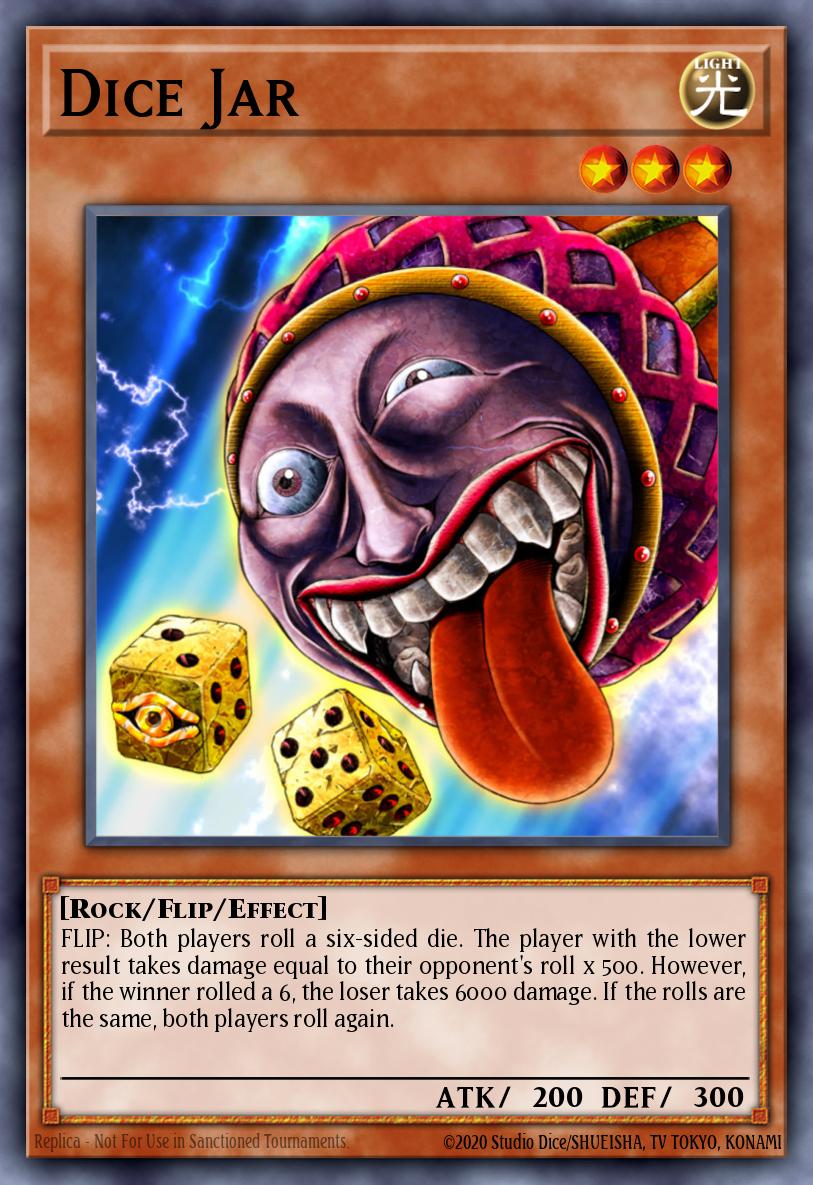
Dice Jar
Archetype:
Dice
ATK:
200
DEF:
300
View:
4877
FLIP: Both players roll a six-sided die. The player with the lower result takes damage equal to their opponent's roll x 500. However, if the winner rolled a 6, the loser takes 6000 damage. If the rolls are the same, both players roll again.
Dice Jar — Power Evaluation
Final Score: 45 ± 8 · Confidence: Medium
- Intrinsic: 45 · Deck: 45 · Meta: provisional
- Primary role: Utility
Why it scores here
Dice Jar turns its flip into a symmetric, high-variance damage roll: the player who rolls lower takes the opponent's roll x 500, or 6000 if the winner rolled a 6, and ties reroll. Both players are equally likely to be the loser, so its expected effect is roughly even and it creates no card advantage or board control. It is included in 45 sampled decks across 27 archetypes, which confirms it is portable and easy to run, not that it is strong; no combo evidence exists to show it converting into a board. The 200-ATK Level-3 body and the absence of combo or guide evidence keep the score in the mid-40s, and the card's low stats earned nothing.
Axis scores
| Axis | Score | Evidence |
|---|---|---|
| Accessibility | 50 | 45 sampled decks run 1.87 copies on average, but there is no starter or searched route evidence in the combo data, so live access is only partly confirmed (observed). |
| Combo & Conversion | 25 | The effect is a damage gamble with no board-building text, and there are zero recorded combo boards to show otherwise (verified text, observed absence). |
| Resource Economy | 20 | No draw, search, refuel or card gain is described; the damage is symmetric in expectation (verified text, inferred). |
| Effect & Interaction | 15 | The effect deals damage to players rather than negating, removing or disrupting any card, so it provides no opponent interaction (verified text). |
| Material Utility | 40 | It is a Level-3 LIGHT Rock body, a generic level and attribute provider, but no material usage was recorded (verified stats, inferred). |
| Resilience & Flexibility | 35 | It is a face-down flip-effect body that depends on being flipped and has no recovery text, so a single removal or negation before the flip ends its value (inferred). |
| Deck-Building Efficiency | 70 | It is a cheap, unrestricted slot with a 3-copy limit assumed, a 1.87 average copy count, and no garnet or lock cost (observed, verified stats). |
Calculation
Weight profile: Utility / no clear role (default); no secondary role blended. Intrinsic ≈ 45, Deck ≈ 45, Meta = provisional. Modifiers: none. Final formula: 0.40*Intrinsic + 0.60*Deck
Strengths
- Included in 45 sampled decks across 27 distinct archetypes, so it is portable across homes
- Cheap, unrestricted body that runs an average of 1.87 copies with no garnet or lock cost
- Its damage roll is clear to resolve and has no complex timing
Weaknesses
- Symmetric in expectation: the player who loses the roll takes the damage, and either player is equally likely to lose
- No board, card advantage or opponent interaction is produced by the effect
- No recorded combo boards, so there is no evidence it converts into a winning line
- Low 200 ATK, 300 DEF body that is fragile before it is flipped
Counters / choke points
- Negating or removing the face-down body before it is flipped (inferred)
- A flip-effect body is only as good as the player who is flipped against; a player ahead on life gains little (inferred)
Best use
Flip-damage finisher and filler body; a symmetric gamble rather than a board-control card. Decks: Dice, Greed, Harpie. Suggested copies: 2.
Evidence & gaps
- Verified: Flip effect: both players roll a d6, the lower roller takes the opponent's roll x 500, or 6000 if the winner rolled a 6, ties reroll (card text); Level 3, LIGHT Rock, 200 ATK / 300 DEF (card data); Appears in 45 sampled decks, average 1.87 copies per deck (deck data)
- Observed: Spread across 27 distinct archetypes, led by Greed at 5 decks (deck data); Most common partner That Six at 53.3% of decks (deck data); Zero combo appearances in recorded boards (combo data)
- Inferred: Expected damage per resolved roll is roughly 3,300 to the loser, symmetric between the two players (calculated from the roll table); Its value depends on being flipped, so removal or negation before the flip ends it (from text and frame)
- Data gaps: no combos supplied, so combo conversion is text-only inference no guides supplied no banlist token, so 3 copies is assumed no usage statistics (StatisticsCard), so archetype inclusion is inferred from the 45-deck sample only no top-card ranking, so popularity is not used